
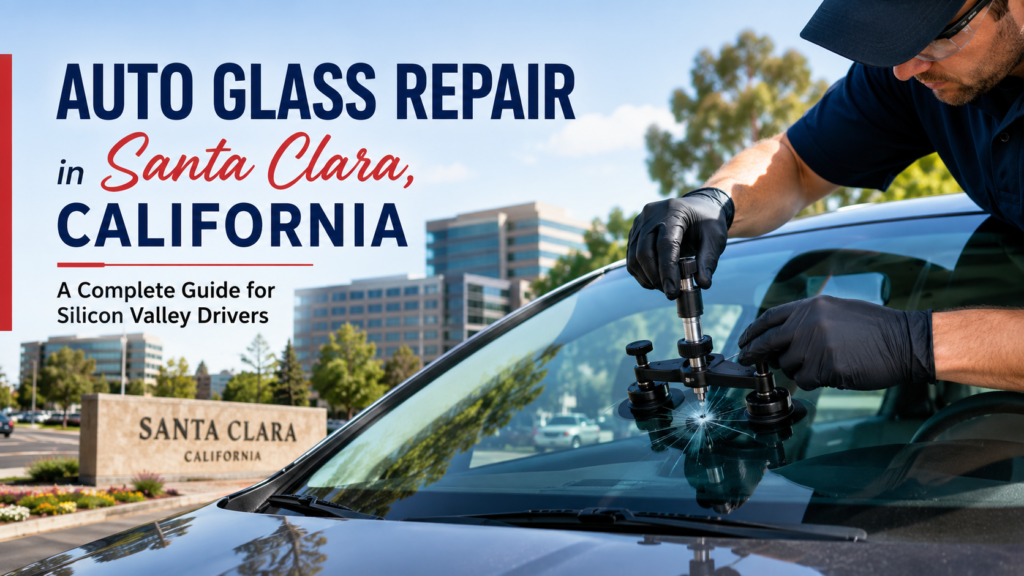
Santa Clara sits at the geographic and economic heart of Silicon Valley, flanked by San Jose to the south, Sunnyvale to the west, and the dense tech corridor stretching north along the Bayshore Freeway toward Palo Alto. Home to Levi’s Stadium, the Intel Museum, California’s Great America amusement park, and the historic Mission Santa Clara de Asis, the city is a unique blend of Silicon Valley innovation and deep California roots. For the 127,000-plus residents and the hundreds of thousands more who commute through Santa Clara every day on Highway 101, Interstate 880, Interstate 280, and State Route 237, windshield chips and cracks are among the most routine vehicle maintenance issues they face. Understanding Auto Glass Repair Santa Clara context what causes damage here, how repair works, when repair is and is not appropriate, and why acting quickly matters equips Silicon Valley drivers to make smart, timely decisions about one of their vehicle’s most important safety components.
Why Santa Clara Drivers Deal with Windshield Damage So Frequently
The driving environment in and around Santa Clara is one of the more demanding for vehicle glass in the Bay Area. Several factors specific to this community converge to create consistent windshield chip risk:
- Heavy truck and freight traffic on 101, 880, and 237: The freeway corridors running through and adjacent to Santa Clara serve enormous volumes of commercial vehicle traffic delivery trucks, freight haulers, construction vehicles, and logistics vans serving the industrial parks, logistics centers, and commercial developments throughout the South Bay. Commercial vehicles with their heavy loads and open cargo areas are among the primary sources of road debris that causes windshield chips. Rocks, fasteners, broken glass, and loose cargo fall from or are thrown by truck tires onto the vehicles following behind.
- Persistent construction activity: Silicon Valley has been in a near-continuous state of construction since the tech boom of the 1990s, and Santa Clara is no exception. New office campuses, mixed-use residential developments, stadium improvements, and freeway infrastructure projects all generate construction zones where loose gravel, aggregate, and material debris create elevated windshield chip risk for vehicles passing through or adjacent to active work areas.
- High daily commute miles: Santa Clara workers and residents log high daily vehicle miles relative to the national average. The daily Highway 101 commute from residential neighborhoods to tech campuses in Santa Clara, San Jose, Sunnyvale, and Mountain View means prolonged exposure to freeway debris at sustained highway speeds. A rock chip that would be a minor nuisance at 35 mph strikes the windshield with significantly greater force and causes significantly more damage at 65 mph.
- Vehicle break-ins: Certain Santa Clara neighborhoods and commercial parking areas experience vehicle break-ins that shatter side windows. While not a windshield chip, broken side glass requires prompt auto glass repair service and is a significant part of the overall auto glass demand in the Santa Clara market.
What Auto Glass Repair Actually Involves
Auto glass repair most commonly refers to the repair of windshield chips and short cracks through a process called resin injection. Understanding the technical details of this process helps drivers evaluate the quality of service they receive and understand what results to realistically expect.
Modern windshields are laminated safety glass: two layers of tempered glass bonded together with a polyvinyl butyral (PVB) plastic interlayer. When a rock or piece of debris strikes the outer glass layer, it creates a void a chip, bullseye, star break, or combination break in the outer glass layer. The PVB interlayer beneath prevents the damage from immediately penetrating through the entire windshield structure. This is what makes repair possible: the void in the outer layer can be filled with a specially formulated clear resin that bonds to the surrounding glass and restores structural integrity.
The resin injection repair process:
- Damage inspection and assessment: The technician examines the chip or crack under lighting conditions that reveal the full extent of damage, including any subsurface cracking that may not be visible in ordinary light. This assessment determines whether repair or replacement is appropriate.
- Area preparation: Any loose glass fragments are carefully removed from the damage point and the surrounding area is cleaned to ensure the resin will bond effectively to uncontaminated glass surfaces.
- Bridge placement: A small suction-cup bridge device is positioned over the damage, creating a sealed chamber around the impact point.
- Resin injection: Optical-quality repair resin is introduced into the void using the bridge’s pressure and vacuum system. Alternating pressure and vacuum cycles work the resin into every crack radiating from the impact, completely filling the void.
- UV curing: An ultraviolet light source is applied to the repair area for the appropriate curing time, hardening the resin to its design strength and bonding it permanently to the surrounding glass.
- Surface polishing: Any excess resin at the glass surface is removed and the area is polished smooth.
The vehicle can be driven immediately after a completed resin injection repair. There is no adhesive curing time required, unlike windshield replacement. Most chip repairs take 30 to 60 minutes from arrival to completion.
The Repairability Question: What Can and Cannot Be Fixed
Not all windshield damage is repairable through resin injection. The determining factors are size, location, depth, and age of the damage:
- Size: Chips smaller than approximately one inch in diameter roughly the size of a quarter are generally good repair candidates. Cracks that are shorter than approximately six inches may be repairable depending on other factors. Larger cracks typically require replacement because the structural compromise is too extensive for resin to adequately address.
- Location: Damage in the driver’s primary line of sight the area directly in front of the driver’s eyes during normal driving requires careful consideration. Even a successful resin repair leaves a slight optical distortion at the repair site. If that distortion falls in the driver’s direct forward view, it can cause visual interference during night driving, in bright sunlight, or in rain. Damage within approximately two inches of any windshield edge almost always requires replacement, because edge damage compromises the urethane adhesive bond between the glass and the vehicle frame.
- Depth: Repairable damage is confined to the outer glass layer. If an impact has penetrated through the PVB interlayer to the inner glass layer uncommon in typical chip scenarios but possible in more severe impacts replacement is required.
- Age and contamination: Fresh damage repairs best. Chips that have been open to the weather for an extended period accumulate road dirt, moisture, and debris that interfere with resin bonding. In the Bay Area, where morning marine layer moisture from San Francisco Bay regularly condenses on vehicle surfaces, chips that have been left untreated for days or weeks are often partially contaminated. Experienced technicians can apply heat lamps to dry the damage area, but thorough contamination reduces repair quality. Acting quickly ideally within a few days of the damage occurring produces the best repair outcomes.
Why Prompt Repair Matters in Silicon Valley
Silicon Valley’s driving conditions create specific reasons why prompt repair of windshield chips is more important than in many other regions. The California summer heat with Santa Clara regularly reaching temperatures in the high 80s and 90s during the June through September period accelerates crack propagation from unrepaired chips. A chip that is stable at 70 degrees Fahrenheit can spread when the vehicle is parked in direct sun and the windshield surface temperature climbs to 140 degrees or more. The thermal expansion of the glass as it heats concentrates stress at the chip boundary and advances cracks outward.
The high daily mileage of Silicon Valley commuters also means that every commute day is an opportunity for a repairable chip to spread into an unrepairable crack. The vibration from rough freeway surfaces, the pressure differential from opening and closing car doors, and the wind pressure at highway speeds all contribute to crack propagation over time. A chip noticed on Monday morning that could have been repaired for a modest amount may by Friday have grown into a crack requiring full windshield replacement at substantially greater cost.
ADAS Recalibration: The Factor Santa Clara Drivers Cannot Ignore
Santa Clara is at the center of the technology industry, and its vehicle fleet reflects that Tesla Model 3 and Model Y vehicles, Subaru Eyesight-equipped SUVs, Honda Sensing models, and vehicles from dozens of other manufacturers with advanced driver assistance systems are common throughout the city. Many of these ADAS systems depend on cameras and sensors mounted to or near the windshield. When a windshield is replaced (not repaired), these camera systems must be recalibrated to the manufacturer’s specifications for the safety features to function correctly.
ADAS recalibration is performed either statically using target boards in a controlled environment at specified distances from the vehicle or dynamically driving the vehicle through a calibration procedure on public roads. The type required depends on the vehicle make, model, and year. Skipping recalibration after replacement means that forward collision warning, automatic emergency braking, lane departure warning, and other safety features may give incorrect alerts or fail to function when needed. For Santa Clara drivers with ADAS-equipped vehicles, confirming that any windshield replacement service includes appropriate recalibration is essential.
California Insurance and Auto Glass Repair
California law requires that insurance companies offering comprehensive auto coverage also make available a zero-deductible option for windshield repair. This means that a qualifying chip repair may be covered at no out-of-pocket cost under many comprehensive policies a provision that reflects the insurer’s recognition that a small repair now prevents the larger replacement claim later. California also prohibits insurers from increasing premiums solely because a driver filed an auto glass claim, removing a common deterrent to using coverage. Santa Clara drivers with comprehensive coverage should confirm their glass repair terms before any service; most chip repairs qualify for zero-deductible coverage.
Conclusion
Auto glass repair in Santa Clara serves a driving community shaped by Silicon Valley’s unique combination of heavy commercial traffic, persistent construction, high daily mileage, and a vehicle fleet increasingly equipped with advanced safety technology that depends on the windshield as a calibration platform. Understanding what auto glass repair involves, what makes damage repairable versus requiring replacement, why Silicon Valley conditions make prompt attention particularly important, and how ADAS recalibration requirements apply to modern vehicles gives Santa Clara drivers the knowledge to respond to windshield damage quickly, accurately, and in a way that fully protects both their safety and their investment.